

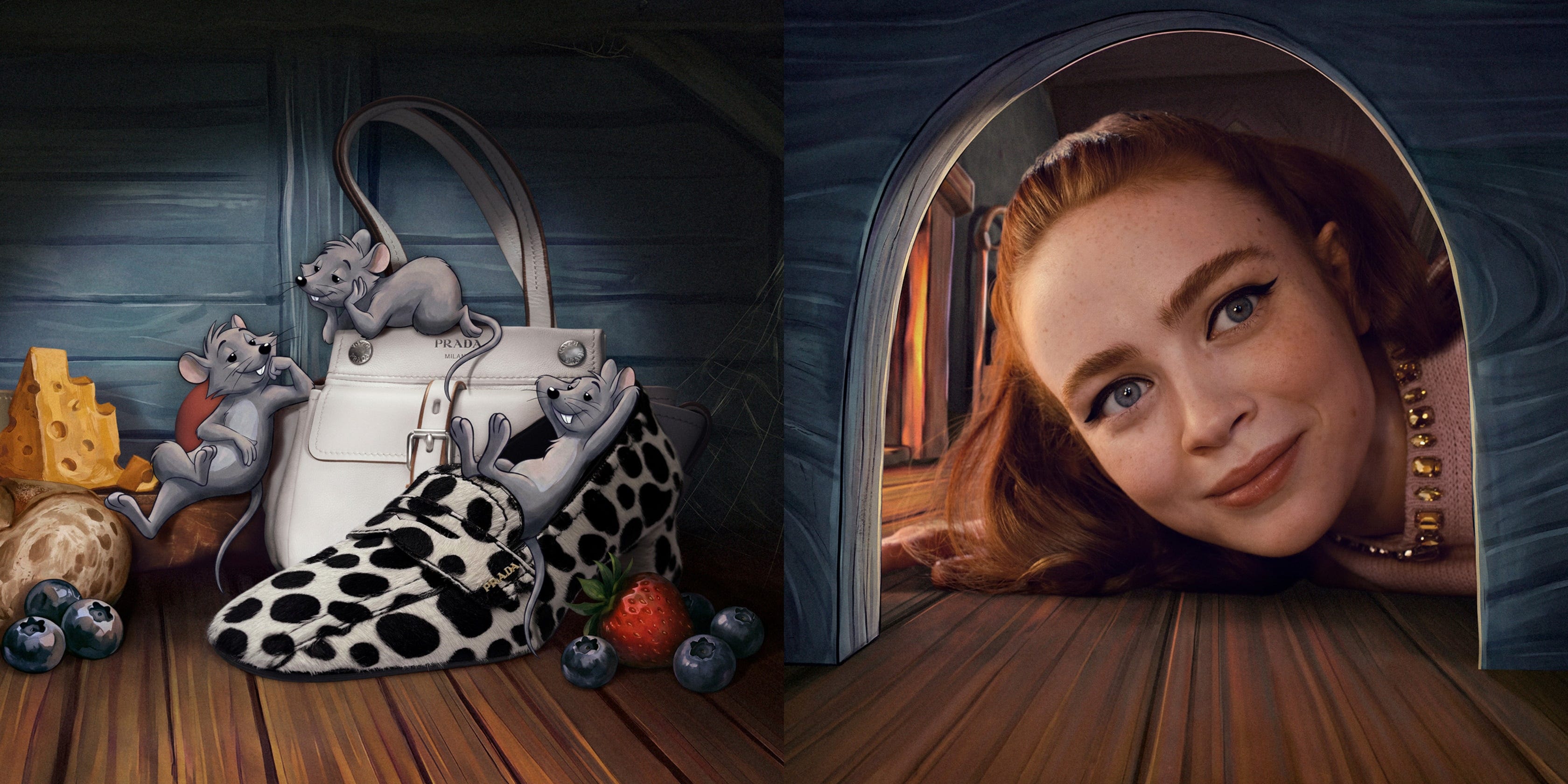
DRAWING PRADA
In March I wrote about the second chapter of Prada’s SS26 campaign with Jordan Wolfson, and about the reaction to it in the comments, quite unanimous and predictable: “AI slop”. My argument was that most of that pushback was labor anxiety, and that the question “is it AI?” had eaten every conversation about what the work actually meant.
In recent days Prada gave its answer. The Holiday campaign is called “Drawing Prada: Animated by Hand”. Sadie Sink loses her shoes to three hand-drawn mice, Maya Hawke walks through the snow in a red dress with an animated fox following her. Glen Luchford is behind the camera, and the animation is by John Pomeroy (Pocahontas, The Secret of NIMH, An American Tail) and Tom Bancroft (Mulan). The creative direction of the campaign is again by Ferdinando Verderi.
I am not a neutral observer here. The logo of this Substack is a tribute to the Fleischer Studios, my daughter is a devoted fan of Betty Boop, and in the last five years, after banning the addictive (CGI) slop of Cocomelon, I rewatched with her all my beloved Disney classics several times. I follow the auctions of original production drawings, on places like Flip Happy Gallery, with the attention other people give to football. In the past I have shot and filmed both Sadie Sink (for Pull & Bear) and Maya Hawke (for AllSaints). And I make AI images for Luxury Houses every day. So I stand on both sides of this: professionally invested in the new technology, emotionally attached to the old craft.
The new campaign moved me, frankly. But not because of the film itself. It moved me because we look at this kind of animation the way you look at something that is almost lost forever. That’s why it is so emotionally charged, and so interesting.
And this is the point, and frankly the not so subtle real subject: the whole message of this campaign is an emotional answer to the anxiety around AI and to the backlash of these months.
Prada never mentions AI, of course. But read the campaign text on its own website: it says the campaign celebrates craftsmanship and the creative process in their very essence, it talks about the human essence of storytelling and about scenery made entirely by hand, and it calls hand illustration a technique “anachronistic and romantic”. Prada itself is telling you that the subject is the process, and describing the technique as anachronistic. It is not about magic or fairy tales. It works because of this, and the beauty of the film is secondary. The real campaign is the choice of using real animation at all, and that choice has the bittersweet sound of a swan song.
And as if the choice of the technique wasn’t enough, together with the images Prada published the process: the pencil sketches, the rough animation, a behind the scenes video where Pomeroy talks about learning his craft with pencil and paper. They went even further: some of the campaign images were shot with the sketches in the background, inside the frame. The proof has moved from the side of the campaign into the image itself, which is metacommunication in its purest form.


In Fashion communication this kind of content has a name and a very clear place: the brand film, and its subject has always been the product, not the image.
The atelier, the hands of the artisan stitching a bag, Loro Piana in Mongolia with the cashmere goats, the hours behind a garment, in order to explain the craftsmanship and justify the price. Campaigns rarely show their backstage, and when they do, it is because the fashion industry itself is part of the values the Brand wants to communicate. Until now, nobody ever felt the urge to prove that a campaign was made by people.
Here Prada takes the language of the brand film and applies it to the campaign. The campaign stops being just the vehicle that gives meaning to the product, and asks to be valued as a handmade object itself, with the backstage there as proof. In March I said that “is it AI?” was the wrong question, because it asks about the tool and not about the work. With this campaign Prada answered exactly that question, and very loudly: it is hand-drawn.
As much as I loved the campaign, my point is that any output born from the anxiety of proving that something is human-made has an expiry date, because no Brand can keep showing the receipts of the shooting in every campaign.
EFFORT SIGNALLING
The trend already has a name. Effort signalling: Brands using real human craft, or showing the work behind the work, in order to demonstrate that it was made by people and not by AI. Victoria’s Secret made clothes out of pasta with a food artist, others went for stained glass, clay stop motion, hand painting, tiny handmade replicas of their own bags etc.
Somebody could say: if the backlash is labor anxiety, as I wrote in March, then hiring real animators is the honest answer to it, and Brands should keep doing it. I agree, and I would love to see it. But supporting human work and using human work as a defensive message are two different things. Crafts survive on steady commissions, on apprentices, on volume, and one beautiful campaign a year is a gesture. A craft needs much more than that to stay alive.
WHY IT CAN’T LAST
I’m not talking about hand-drawn animation, or about craftsmanship in general: Brands can keep commissioning beautiful human work forever. I’m talking about craftsmanship used as a defense, as proof that it wasn’t AI. That kind of proof can’t last, because it is simply impossible to do it every time.
You can do it once. You can do it a couple of times, on special occasions, when the campaign lives on Instagram and the backstage can sit next to it. But a campaign lives on billboards, on magazine pages, on the side of a bus, and the proof can’t travel with it. What do you do, put the receipts of the production company on a billboard in front of the Chateau Marmont? Prada actually tried, putting the sketches inside the shot, but on a billboard a sketch is just another image. And explaining yourself every season is the posture of the accused, which is the one posture Luxury never kept for long.
And Communication can’t keep chasing alternative formats chosen only because they unmistakably imply a real artist. It is already quite clumsy today, and it doesn’t even hold: the tiny handmade Chanel bags, frankly, can already be done realistically with a few good AI tools. Put simply, a Brand can’t keep circling around metacommunication, with campaigns about Brand values that end up talking about how the campaign was made.
And this is the irony: when a Brand makes something by hand in order to prove it didn’t use AI, AI has already decided the terms of the conversation, even when it is rejected as a tool.
And this is today, when the difference between AI and human made is still appreciable. In March I wrote that I work with these tools every day and I had to check carefully to understand if AI was involved in the Wolfson images. Even now, with a difference you can still see if you look carefully, Brands already feel the anxiety of proving that it wasn’t AI. Imagine a time when there is no appreciable difference at all. Today you still can’t mimic Disney animation perfectly with AI, and that’s why Pomeroy’s mice still prove something. Sooner or later you will, and I do believe sooner. It is inevitable, and we know it. At that point an original Pomeroy drawing will still be an original Pomeroy drawing, but what you see on the screen won’t be enough anymore to prove where it comes from, not the mice and not the sketches next to them.
Effort signalling in campaigns has an expiry date, and the anxiety behind it will keep growing while the proof stops working.
WHAT HAPPENS NEXT
So what happens after? My intuition tells me that Brands will stop proving, first because it is exhausting and then because it is impossible: you can’t keep working in crisis management mode forever. The proof of the hand will go back where it always belonged, to the brand films and to the product, where there is a physical object and a physical hand that you can actually go and see.
And for the campaigns, the images that carry the Brand values, the conversation will be pushed back to the work itself. My position on this has always been quite simple: slop is slop, good is good, as I wrote in my first piece on this Substack.
Today the market pays for the proof of the hand. When the hand can’t be shown anymore, it will have to go back to asking if the work is any good, and if it carries any real meaning, whatever the tools that made it.